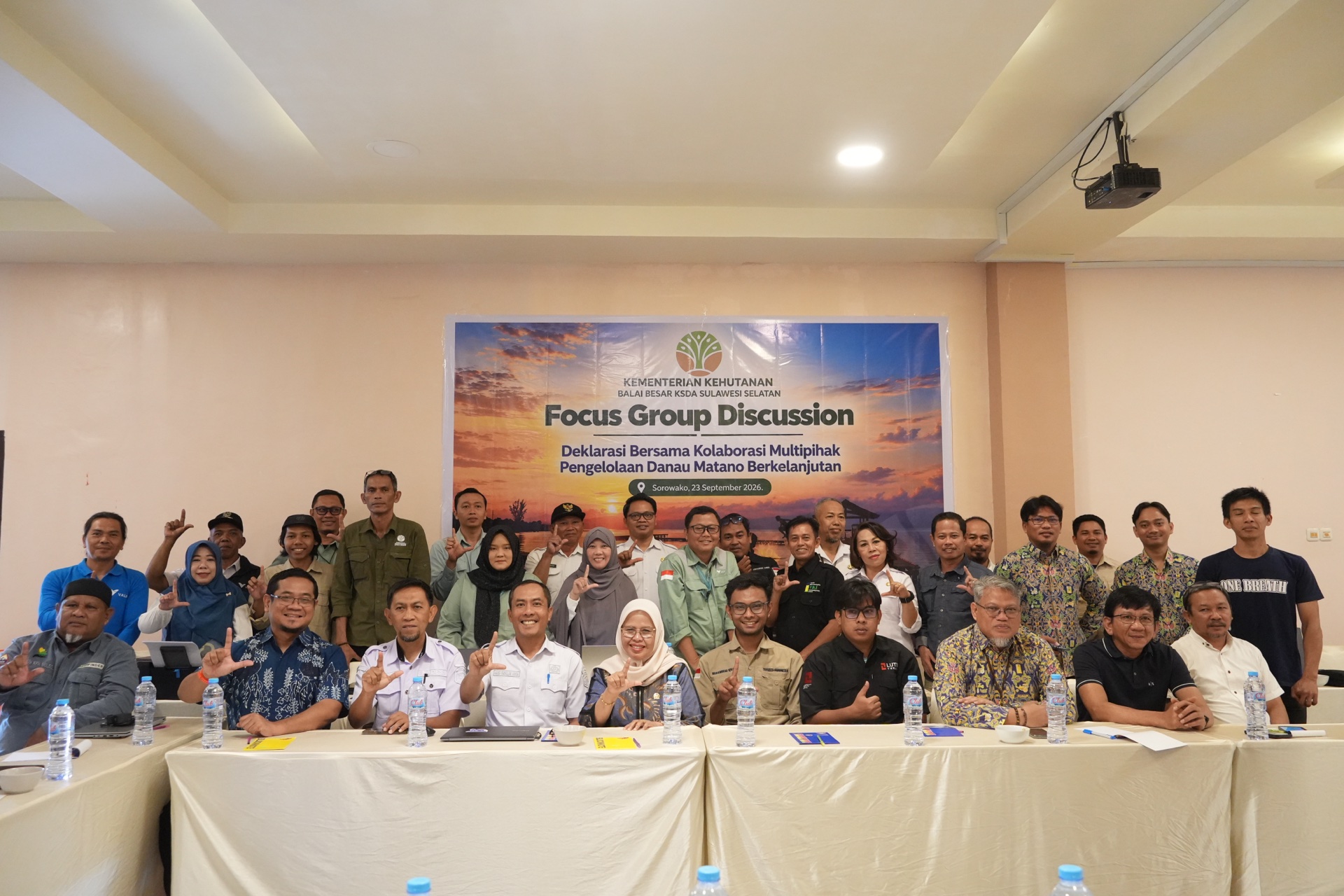
SOROWAKO, September 23, 2026 –
Preserving the ecological integrity of Lake Matano requires a collaborative
approach involving government institutions, businesses, environmental
organizations, local communities, and other stakeholders. As an integral part
of the ecosystem surrounding Lake Matano, PT Vale Indonesia Tbk (“PT Vale”)
supports collaborative initiatives aimed at ensuring the lake’s long-term
sustainability.
The commitment was reaffirmed
during the Focus Group Discussion (FGD) on the Joint Declaration for
Multi-Stakeholder Collaboration on the Sustainable Management of Lake Matano,
organized by the Natural Resources Conservation Agency (BBKSDA) of the Ministry
of Forestry, with support from PT Vale, at Mireya Hotel on Wednesday (September
23, 2026). The forum served as a platform to strengthen perspectives and shared
commitments toward advancing sustainable management of Lake Matano.
During the discussion, PT Vale
presented various initiatives undertaken to support the sustainability of the
Lake Matano ecosystem, including conservation and community empowerment
programs, water quality management associated with operational activities, and
progressive land reclamation in mined-out areas.
Sainab Husain Paragay, Senior
Coordinator of Livelihood Development, Community Development and Empowerment
(PTPM) at PT Vale Indonesia, explained that the Company's conservation approach
extends beyond environmental protection to include community participation and
the creation of socio-economic benefits that contribute to long-term program
sustainability.
One example is the Matano Iniaku
Conservation Program, implemented through various initiatives such as
agroforestry and community nursery development, watershed rehabilitation,
ecotourism development, creative economy enhancement, and community capacity
building for disaster preparedness.
“Conservation efforts cannot
stand alone. We need active community participation and support from various
stakeholders to ensure that the programs implemented create lasting impacts.
That is why collaboration plays a vital role in safeguarding the Lake Matano
ecosystem,” said Sainab.
In addition to Matano Iniaku, PT
Vale has introduced several initiatives that connect conservation efforts with
community empowerment. These include utilizing the invasive aquatic plant Hydrilla
as raw material for compost production, as well as processing invasive fish
species such as Janitor Fish (Sapu-Sapu) and Flowerhorn Fish (Louhan) into fishmeal
or livestock feed.
The programs involve
environmentally conscious youth groups, local fishers, and spearfishing
communities. This approach is expected not only to help control invasive
species populations but also to create economic opportunities by transforming
these resources into value-added products for local communities.
PT Vale’s commitment to the
sustainability of Lake Matano is also reflected in its water management
practices within operational areas. The Company employs an integrated water
management system to control runoff from operational sites before it is discharged
into natural water bodies.
According to Andri Ardiansyah,
Biodiversity Specialist at PT Vale Indonesia, water originating from
operational areas is controlled and undergoes treatment prior to being released
into the environment. Continuous monitoring and water quality management are
conducted to ensure discharged water complies with applicable environmental
quality standards and regulatory requirements.
“This approach is part of PT
Vale’s efforts to ensure that operational activities are carried out while
maintaining the protection of environmental quality and surrounding water
bodies,” Andri explained.
Beyond water management,
environmental protection is further strengthened through progressive
reclamation, whereby land rehabilitation is conducted gradually on areas that
have completed mining activities, allowing land recovery processes to proceed
alongside ongoing operations.
The reclamation process includes
backfilling, land contouring and preparation, topsoil spreading, erosion
control, fertilization using compost and NPK, the planting of cover crops and
pioneer species, as well as maintenance activities until sustainable vegetation
is successfully established.
This approach demonstrates that
environmental management is not limited to active operational periods but also
encompasses the systematic restoration of land after mining activities have
concluded in a particular area.
PT Vale also recognizes that the
sustainability of Lake Matano is a shared responsibility that requires a
cross-sectoral approach. Government institutions and relevant authorities play
a critical role in policy and regulatory frameworks, while environmental
organizations, academics, communities, civil society groups, and businesses can
contribute through expertise, innovation, participation, and resource support.
Accordingly, PT Vale remains open
to collaborative opportunities with various stakeholders to advance
conservation efforts and support the sustainable management of Lake Matano.
Eru N. Dahlan, Head of Technical
Affairs at the South Sulawesi Natural Resources Conservation Agency (BKSDA),
emphasized that multi-stakeholder strategic collaboration is increasingly
important given the growing challenges facing Lake Matano's conservation due to
limited institutional integration.
“We believe that efforts to
preserve Lake Matano require synergy and collective action among all relevant
stakeholders. Many parties are working independently, which can lead to
overlapping initiatives or, conversely, leave important areas unaddressed,” Eru
stated.
He added that the forum was
intended to align perspectives and strengthen coordination among stakeholders.
“That is why we invited all
relevant stakeholders to share their views, discuss what has been accomplished,
and outline future plans. Where there are opportunities for collaboration, we
should pursue them together with greater commitment. We hope this initiative
will facilitate stronger coordination and collaboration moving forward,” he
explained.
The multi-stakeholder collaboration is expected to foster a more integrated approach to safeguarding Lake Matano, transforming conservation efforts from separate institutional agendas into a collective movement to ensure the sustainability of its ecological, social, and economic functions for present and future generations.
